Saturday, 15 March 2014

Tapered shaft lock :-Shaft Couplers (Transmission)

These are kind of locking device used as key-less shaft coupling. They are assembled to transmission components like gears, pulleys, timing pulley, as bushes etc. generally, where no play is must for the transmission between shaft and transmission element. The main applications of these are in CNC machines, which are very precise. Today, because of intense pressure to maximize uptime, precision, and efficiency while minimizing material, machining, and operating costs, key-less frictional locking devices are the hot trend. The basic idea is similar to a clamp coupling but the moment of rotation is closer to the centre of the shaft. In traditional keys, there were possibilities of worn out, which are removed by using these coupling devices. It is more robust than using a key because maintenance only requires one tool and the self-centering balanced rotation means it lasts longer than a keyed joint would, but the downside is that it costs more.  Below, I have added some pictures of these, used in timing pulleys, from which you can get an idea of how to assemble them.


So here, I have these 2 screws, which tight the lock using L key. There is also a long single screw, which is just right on the other-side of staring line opening, which is used to disassemble or take out the nut from timing pulley. These are available in the market in standard sizes at cheap prices.

Thursday, 6 March 2014

Fool's Play :- Pulley lift system (Mechanics)

Lifting heavy loads are very common in the industries.For example, lifting weights of products being manufactured are quit common in factories. Now while designing such lifting machines, a designer may face various constraints, which can restrict his choice to use heavy power machine elements like motors or actuators to deal with such loads.

Here is an very simple, cost effective trick, which is, by using pulley and wire rope system to divide the weight into various wire rope connections, resulting in reduction in load for actuators or motors to lift the same weight. But the actuator or motor has to pull rope for longer distance though. Diagram given below, explain it quit well.

W= Weight, T= Tension , F= Force in Newtons, H= Height.


All you need is :
1. A wire rope , which can be standard and can be chosen according to the weight to lift., 
2. A Sheave ( Pulley), which is also available as standard part and is chosen according to wire rope chosen,
3. And then you need a shaft, bearing, sheet-metal housing and nuts to make the coupling. 

Various other ways to make pulley connection according to space constraints are given below:


Monday, 17 February 2014

FEA Analysis (Using Hyperworks and Ansys)

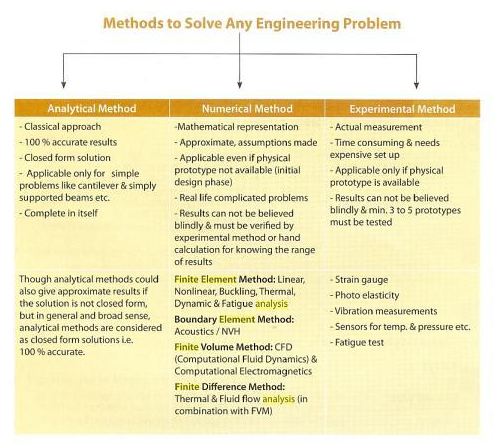
To analyse, the maximum stress and strain, a machine or machine components can face, it become very hard to make calculations by conventional formulas, of stress and strain, while making calculations for complex geometrical shapes, made up  different materials, complex loading varying with time etc. For example, to calculate the stress at any point of engine body, it would take months to make calculations by using various formulas. Now, that technique is called scientific approach toward the problem, also called Analytical Method. In the beginning   of 20th century, mathematicians developed various Numerical Methods, which make problem solving faster, though gives you a solution correct upto about 90%, unlike Analytical methods which gives a 100% correct solution. In the Industry, time is a very important aspect in the development of project or product. Now for example, To develop a product, in least time, Analytical methods would make calculations very long, and thus would make it hard to achieve goals in time. Thus for that purpose, Industry uses Numerical methods to make calculation of various forces while developing a product, which are fast, even though they are not as much accurate as analytical methods, as Industry can compromise a accuracy of about 10% before time. The product is made by approximations, and assumptions, and the results achieved by numerical methods can not be trusted blindly, and thus, they make prototypes and test experimentally, by experimental methods in the company's protoshops. If prototype passes,the product drawings are  finalized and are released. The various methods and various Numerical methods, which are of our main concern, are discussed below briefly.

I have been providing, random mechanical studies. I have decided to make a new blog about FEA Analysis, in which I will give complete knowledge about the subject of Strength of Materials, Finite element methods, and use of software to make calculations even more faster, by Hypermesh and Ansys. The Finite element method, in Numerical methods, solves a problem, lets say a stress analysis on big sheet metal surface, by dividing the sheet metal part into many small parts, in the form of quads and trias, made of nodes, and those small parts are called elements. By dividing into small parts by a process called meshing, the stresses in each elements are calculated, and are added up to achieve the final solution.


 Now, the small parts called elements can be in large amounts, resulting in large calculations to be made and we use computer softwares to make large calculations easy. I will soon update you with my new blog about FEA Analysis, as soon I make it.

Sunday, 2 February 2014

NC Milling with trick! :-CAM:

I got this piece to machine on NC milling machine. Now this piece would take long time to be machined, as the mill in the slanted circular shape would take long time. But here I made a trick, with the use of fixture, and prepared the special geometry of milled part, that you can ask me via e-mail. This trick helped me to prepare its CAM program, by just making it as 2D model, yet it looks like its CAM program is only possible by making a 3D model. I'm sharing here not its 2D model, yet its 3D though! This cunning trick helped to reduced the cost & time of machining, and thus optimized it's production.


Wednesday, 29 January 2014

SPROCKET:-Transmission:

Sprocket is an gear like element used in chain transmission system. The best example of it is in Bicycles, in chain mechanism.Now, the chain transmission system is pree common, and designer would need to model it on CAD software with perfect involute curve in its teeth. Here below, I made 30 teeth sprocket, with perfect involute curve in its teeth. You can go to 'http://www.gearseds.com/files/design_draw_sprocket_5.pdf' to see how I made it on my CAD software.

Also, If you are using Pro/E to model the sprocket with above steps, use construction lines to make final involute curve. I think that's the best way to make it by Pro/E, as if you make the curve by depending on regular lines, when you will trim them, the left involute curve will ask for dimensions again. Do it like this below:

Manufacturing: Now Don't even think, that you can make it on VMC's without cam. These are generally manufactured on Hobbing machines, using a sprocket hobb cutter. The choice of using cutter depends upon no. of sprocket teeths and size, which in turn depends upon selection of chain, eg. chain no.25,35,41,40 etc. Here below, is the picture of typical sprocket hobb cutter!

Thursday, 5 December 2013

KEYED JOINTS

Ever wonder how machine element which rotates with shafts, how are they joined? Well, there are many ways, but one of the most effective and easy way is to use a key. A key is a machine element used to connect a rotating machine element to a shaft. The key prevents relative rotation between the two parts and enables torque transmission.A key is used for temporary fastening. For a key to function, the shaft and rotating machine element must have a keyway, also known as a keyseat, which is a slot or pocket the key fits in. The whole system is called a keyed joint.They are used in many components like pulleys, clutches, gears etc. Like, most of machine elements, they are also of many kinds. I will here discuss the simple type of Keyways. You can use your Pro/E's, Solidwork's etc to design them in modelling and apply standard tolerances during drafting. Below is the picture of designing a simple standard key for a shaft.For the bores and for other kinds of keyed joints, you can look for over internet or various design books.


Machining: They are generally machined on shafts by using milling machines. The rotating tool of vertical mill removes metal from the surface of shaft.In the shafts they look like this.

Machining of square keyways in bore of shafts, gear, or pulleys etc is done by machine called slot machine. It uses a tool in the form of bit of HSS material, which can be grinded to desired dimensions to machine desired keyways in the bore. The tool moves up and down and machines the Keyway. Below are the photos of slot machine and its keyway tool.


The large Keyway being made in the bore of large spiral bevel gear of 5 module by slot machine.

Wednesday, 20 November 2013

RUN OUT ERROR OF GEAR TEETH:-Gear Meteorology and Measurement:

This error is used to know the run out of pitch circle of the gear.It is the error in radial position of the teeth.
Run out error causes various vibrations and noise in the gear mechanism. To completely remove it, the manufactured gear is hardened, and then grinded. Grinding removes this error completely, and hardening prevents it to get oval after gear mesh when used. One example of use of such gears is below in the photos.The gear in the photo is, used in pump for hydraulics. In order for gears to create the sufficient pressure, it should have no run out error.
There are various ways to measure it, such as computerized machines which work with air pressure and give whole reading of gear teeth profile and run out. Most often it is measured by indicating the position of pin inserted in each tooth space around the gear and taking the largest difference. Another way is, generally for fine pitch gears, to roll the gear with master gear on a variable centre distance fixture, which measure and record the change in the centre distance as the measure of teeth or pitch circle run out.
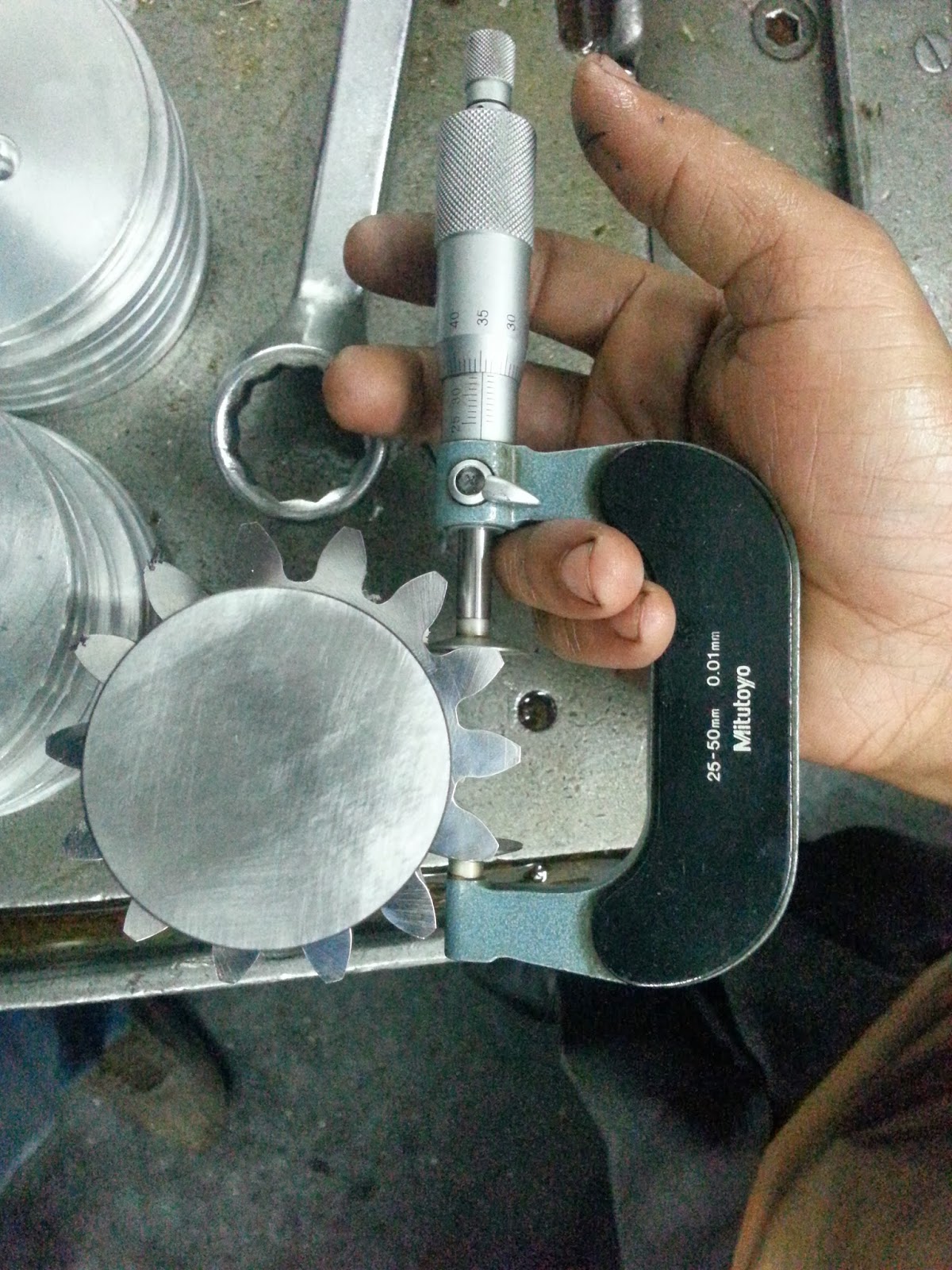
The method that I used here is a simplest one, and the most fastest. I used a screw gauge and measured the run out in each of group of three teeth, I selected the number 'three' for screw gauge to measure the error with MOT formula. The cutting and grinding of teeth was done in the company. The Reading was found to be 34.44 in each of group, and hence the run out was 0.